Series Overview
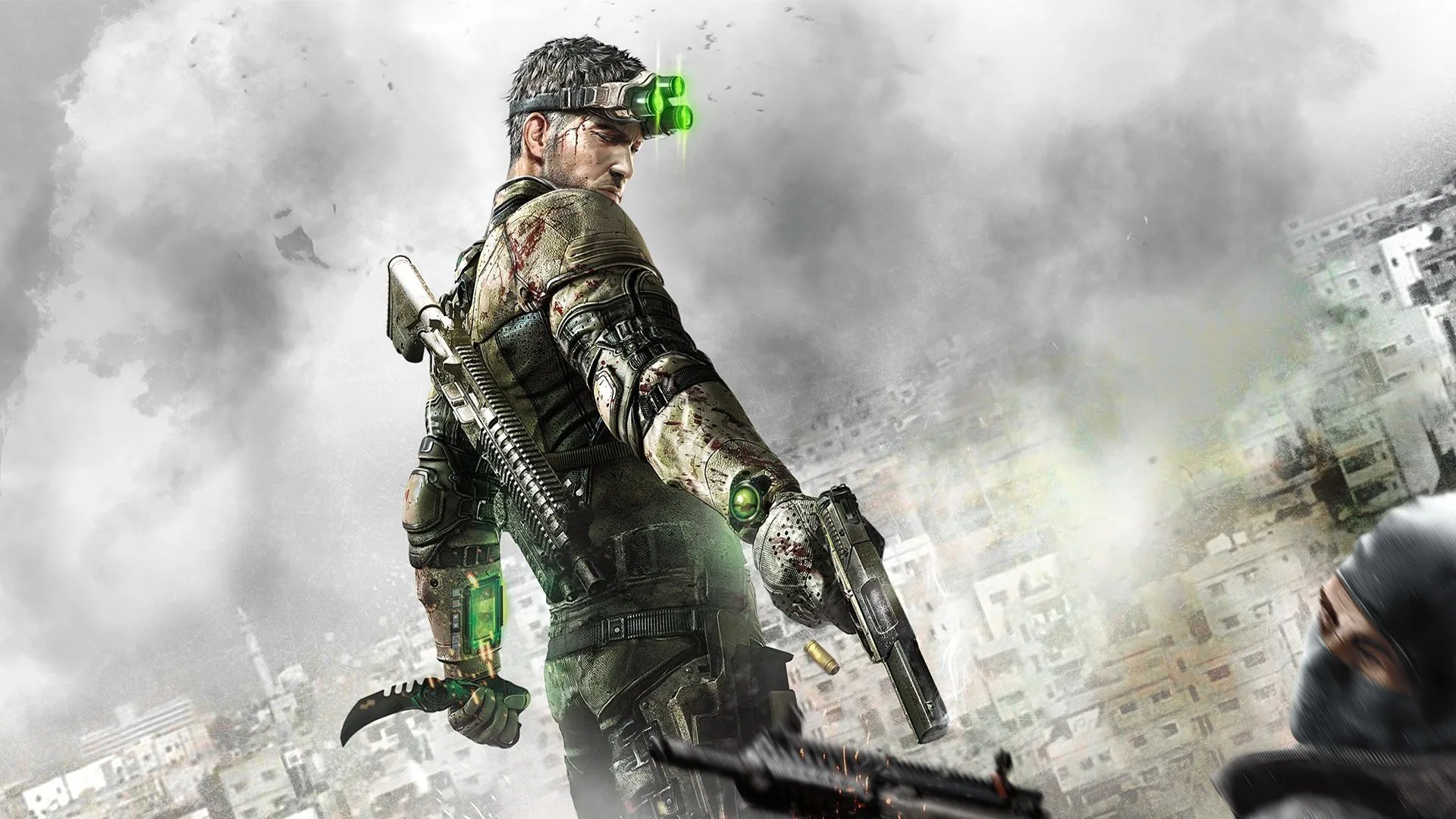
Tom Clancy's Splinter Cell is a seminal tactical stealth-action game series developed by Ubisoft Montreal and published by Ubisoft. The series began in 2002 with the self-titled Tom Clancy's Splinter Cell, and is available on Windows, Xbox, PlayStation 2, PlayStation 3, and various handheld platforms. Renowned for its focus on light-and-shadow mechanics and intricate geopolitical narratives, the franchise has become a cornerstone of the "techno-thriller" genre, prioritizing surgical precision over blunt force.
Release Order Complete list of games series in Release Order.
| # | Game Title | Year | Platforms | |
|---|---|---|---|---|
| 1 | Tom Clancy's Splinter Cell | 2002 | Xbox, PC, Mac, PS2 | |
| 2 | Tom Clancy's Splinter Cell: Pandora Tomorrow | 2004 | Xbox, PC, PS2 | |
| 3 | Tom Clancy's Splinter Cell: Chaos Theory | 2005 | Xbox, PC, PS2 | |
| 4 | Tom Clancy's Splinter Cell: Double Agent | 2006 | Xbox 360, PC, PS3, Xbox, PS2, Wii | |
| 5 | Tom Clancy's Splinter Cell: Conviction | 2010 | Xbox 360, PC, Mac | |
| 6 | Tom Clancy's Splinter Cell: Blacklist | 2013 | Xbox 360, PC, PS3, Wii U |
Chronological Order Complete list of games series in Chronological Order.
All Tom Clancy's Splinter Cell Series Overview Each game's plot guide includes minor spoilers.
1. Tom Clancy's Splinter Cell (2002)
Retired Navy SEAL Sam Fisher is reactivated to join Third Echelon, a fledgling branch of the NSA designed to conduct invisible operations in an age of digital volatility. His inaugural assignment sends him to the Republic of Georgia to investigate the suspicious disappearance of two CIA agents. What begins as a routine extraction quickly unravels into a far-reaching conspiracy involving Georgian President Kombayn Nikoladze and his ambition to reshape regional power through information warfare. Fisher finds himself navigating a landscape where the shadows are his only sanctuary against a technologically superior foe.
The friction intensifies as Nikoladze initiates a devastating cyber-assault on United States infrastructure, plunging the nation into logistical paralysis. Fisher must infiltrate highly secure environments—from the Georgian Presidential Palace to the heart of the CIA's own headquarters—to eliminate the threat at its source. The narrative highlights the terrifying reality of state-sponsored terrorism conducted via fiber-optic cables rather than traditional artillery. Sam’s reliance on his handler, Irving Lambert, becomes the only anchor in a mission where a single exposure could ignite a global catastrophe.
The thematic tension rests on the fragility of the post-Cold War peace and the emergence of "glass-room" diplomacy. Fisher discovers that Nikoladze has a catastrophic fail-safe prepared, a localized nuclear threat codenamed "The Ark." As the clock ticks toward an irreversible detonation on American soil, Fisher is forced to operate with a cold-blooded efficiency that blurs the line between a soldier and an assassin. He stands at the threshold of Nikoladze's final stronghold, wondering if the secrets he buries today will haunt the world's tomorrow.
2. Tom Clancy's Splinter Cell: Pandora Tomorrow (2004)
In the spring of 2006, the United States establishes a military presence in the newly independent East Timor, sparking a violent backlash from Indonesian anti-separatist militias. Suhadi Sadono, the charismatic leader of the "Darah Dan Doa" militia, orchestrates a brutal raid on the U.S. Embassy in Dili. Sam Fisher is deployed to infiltrate the militia's network and neutralize Sadono’s influence before the region descends into total anarchy. However, Fisher soon realizes that Sadono is not merely a local insurgent, but a man with a global biological contingency.
Sadono reveals his "Pandora Tomorrow" fail-safe: smallpox-encrypted canisters dispersed across the United States, set to be released if he is killed or captured. This biological blackmail forces Fisher into a lethal game of cat-and-mouse across Paris, Los Angeles, and the Indonesian jungle. He must track the "carriers"—sleeper agents tasked with the virus's release—while keeping Sadono alive to prevent the countdown from triggering. The psychological pressure of an invisible, airborne plague turns every encounter into a high-stakes gamble with millions of civilian lives at stake.
The core tension focuses on the limitations of U.S. interventionism and the desperate measures used to maintain plausible deniability. Fisher’s relationship with his team is strained by the shifting directives of a government terrified of a public health catastrophe. The narrative explores the ethics of a "surgical strike" when the enemy has already integrated themselves into the heart of the target nation. As Fisher closes in on the final virus carrier in a bustling international airport, he faces a moral quagmire where the safety of the world demands the absolute erasure of his own humanity.
3. Tom Clancy's Splinter Cell: Chaos Theory (2005)
The year is 2007, and the Pacific Rim is a powderkeg following the creation of Japan's Information Self-Defense Force, a move that China and North Korea view as a violation of post-WWII treaties. Massive cyber-attacks cause blackouts in Tokyo and New York, pushing the world's superpowers toward a state of total mechanized war. Sam Fisher is sent to investigate the kidnapping of Bruce Morgenholt, a computer programmer whose work on "Masse Kernels" holds the key to the world's digital infrastructure. He soon discovers that an old acquaintance, Admiral Otomo, is manipulating the chaos to restore Imperial Japan's former glory.
The narrative escalates as Fisher uncovers a plot involving intentional missile launches meant to provoke a full-scale invasion of South Korea. He must navigate the rain-slicked streets of Seoul and secret subterranean bunkers, sabotaging the algorithms that have turned global communication into a weapon. The friction between Third Echelon and rival intelligence agencies creates a web of double-crosses where no data can be trusted. Fisher's cynical wit is tested as he realizes that the "Chaos Theory" of modern warfare means that a single line of code can be more lethal than a carrier group.
The thematic focus centers on the obsolescence of traditional boundaries in an era of information dominance. Fisher’s friendship with his technical expert, Anna Grímsdóttir, provides a rare moment of levity as they witness the world teetering on the edge of a third World War. The burden of preventing a nuclear exchange falls entirely on Sam’s ability to remain undetected in the belly of the beast. He faces a final confrontation in a high-tech Japanese command center, where he must decide if his loyalty to the mission outweighs his duty to the truth.
4. Tom Clancy's Splinter Cell: Double Agent (2006)
Sam Fisher’s world collapses when his daughter, Sarah, is killed in a tragic hit-and-run accident, leaving him a hollowed-out shell of his former self. Seeking an escape from his grief, he accepts a high-risk deep-cover assignment that requires him to infiltrate a domestic terrorist organization known as John Brown's Army (JBA). To gain their trust, Fisher must facilitate a prison break and participate in criminal activities that contradict everything he once defended. He becomes a "Double Agent," navigating a lethal social landscape where the NSA and the JBA demand absolute and conflicting loyalties.
The conflict intensifies as Sam is ordered to carry out atrocities to prove his commitment to the JBA’s nihilistic cause. He finds himself caught in a psychological meat-grinder, building a genuine rapport with the charismatic JBA leader, Emile Dufraisne, while secretly reporting back to a frustrated Irving Lambert. The narrative forces Fisher to sabotage his own government's interests to maintain his cover, leading to a profound erosion of his identity. Every choice he makes is a binary struggle between preserving his mission and retaining what is left of his moral core.
The thematic tension explores the corrosive nature of lies and the personal cost of "the greater good." Fisher discovers that the JBA has acquired a red mercury nuclear device intended for a strike on New York City, and he must stop the detonation without alerting the terrorists to his true identity. The relationship between his two lives reaches a terminal point where he is forced to commit an act of ultimate betrayal against one of his masters. He stands in the dark of a high-security compound, his finger on the trigger, facing a choice that will define him as either a patriot or a murderer.
5. Tom Clancy's Splinter Cell: Conviction (2010)
Fisher has abandoned Third Echelon, living as a fugitive while obsessively hunting the people responsible for his daughter’s death. His clandestine pilgrimage takes him to Malta, where he learns from former colleague Anna Grímsdóttir that Sarah might still be alive. This revelation pulls him back into a web of institutional corruption, revealing that Third Echelon has been compromised by a rogue director named Tom Reed. Sam is no longer a surgical tool of the state; he is a vengeful predator fueled by a father’s rage.
The narrative transforms into a high-stakes hunt through the streets of Washington D.C., as Fisher uncovers a coup d'état aimed at the U.S. Presidency. Reed plans to utilize an EMP strike to decapitate the government, using Third Echelon's resources to install a puppet regime. Fisher must reunite with his old friend Victor Coste, relying on black-market gear and brutal interrogation tactics to bypass the agency he once served. The friction between Sam’s instinctual violence and the strategic requirements of the mission creates a frantic, desperate pace as the capital falls into shadow.
The core tension focuses on the betrayal of the institutions that Fisher dedicated his life to protecting. He must confront the realization that his daughter was used as a pawn to control him, turning his grief into a weapon for his enemies. The thematic weight rests on the idea of "conviction"—the personal resolve required to stand against a corrupt system when all official support is gone. As Fisher infiltrates the White House to stop the final assassination, he faces a moral reckoning where the line between justice and vengeance becomes razor-thin.
6. Tom Clancy's Splinter Cell: Blacklist (2013)
Following the dissolution of the corrupt Third Echelon, the President forms "Fourth Echelon," an elite, mobile unit commanded by Sam Fisher himself. A group of terrorists known as "The Engineers" initiates "The Blacklist," a series of escalating attacks on U.S. strategic interests worldwide. They demand the total withdrawal of all American troops from foreign soil, threatening a new catastrophe every few days until their conditions are met. Fisher and his team, operating from the Paladin aircraft, must hunt the Engineers across the globe before the countdown reaches its final, devastating stage.
The conflict escalates as Fisher tracks the Engineers' mastermind, Majed Sadiq, through the shadows of Benghazi, London, and Tehran. The mission is hampered by internal friction within Fourth Echelon, particularly between Sam and the ambitious Isaac Briggs, as they struggle with the weight of leadership. Each "Blacklist" event—from the contamination of water supplies to the destruction of fuel reserves—pushes the American public closer to a state of total panic. Fisher finds himself in a race against an enemy that is always three steps ahead, utilizing his own tactics against him.
The thematic tension centers on the burden of command and the ethics of preemptive warfare in a post-9/11 world. Fisher must balance his role as a field operative with his responsibility for his team's survival, realizing that the "Fifth Freedom" carries a weightier cost than he ever imagined. The narrative explores the idea that the world is a battlefield without borders, where the only thing preventing total collapse is a group of people who officially do not exist. As the final attack on American soil looms, Fisher must decide if he is willing to sacrifice everything to stop Sadiq from uttering his final word.
All Tom Clancy's Splinter Cell Games in Order: A comprehensive list of the franchise, organized by release and chronological order. Information is curated from web sources and highlights mainline entries only. Note: This guide does not include DLCs or remakes, focusing strictly on primary Tom Clancy's Splinter Cell titles for a cleaner browsing experience.