
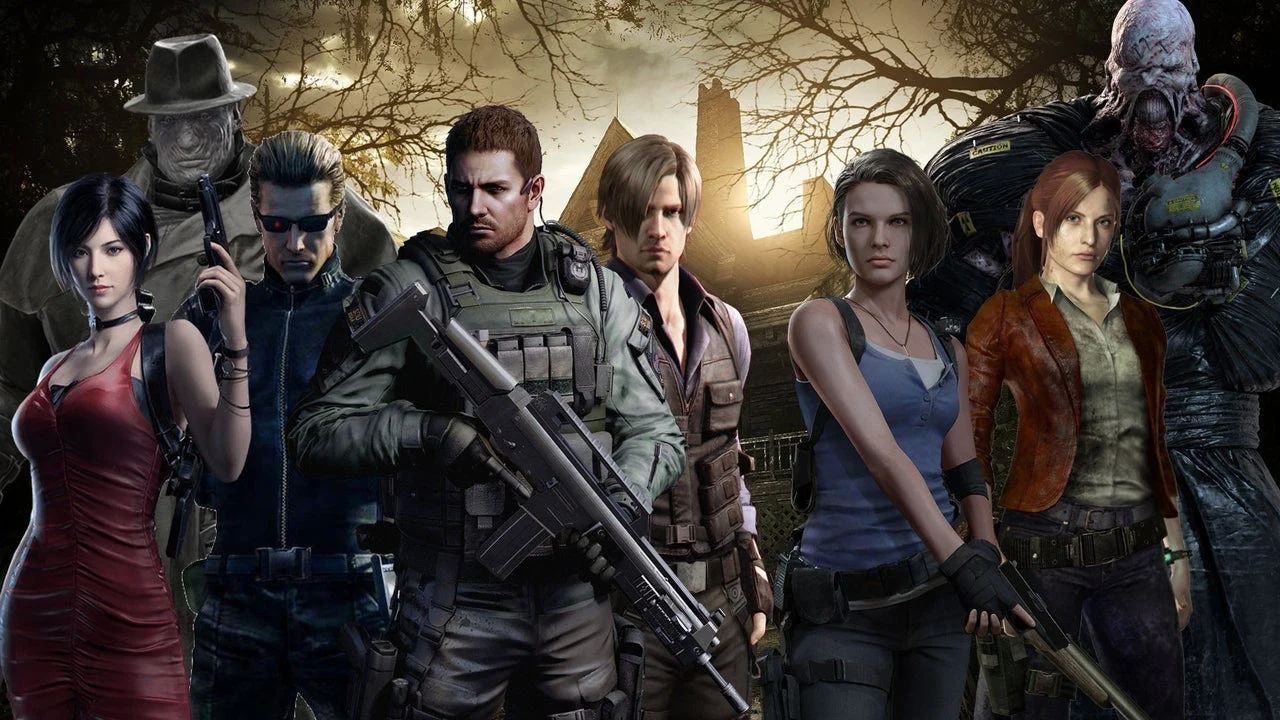
Series Overview
Resident Evil is a seminal survival horror game series developed by Capcom and published by Capcom. The series began in 1996 with Resident Evil, and is available on PlayStation, Xbox, Nintendo, and PC. Over three decades, the franchise has defined the genre, shifting from fixed-camera puzzles to third-person action and first-person immersion while maintaining its core identity of resource management and atmosphere.
Release Order Complete list of games series in Release Order.
| # | Game Title | Year | Platforms | |
|---|---|---|---|---|
| 1 | Resident Evil | 1996 | PC, Mac, PS3, PS4, Xbox 360, Xbox One, Switch | |
| 2 | Resident Evil 2 | 1998 | PC | |
| 3 | Resident Evil 3: Nemesis | 1999 | PC | |
| 4 | Resident Evil:Code: Veronica | 2000 | PS2, PS3, Xbox 360 | |
| 5 | Resident Evil (2002) | 2002 | PC, PS3, PS4, Xbox 360, Xbox One, Switch, Wii | |
| 6 | Resident Evil Zero | 2002 | PC, PS3, PS4, Xbox 360, Xbox One, Switch, Wii | |
| 7 | Resident Evil 4 | 2005 | PC, PS2, PS3, PS4, Xbox 360, Xbox One, Switch, Wii, iOS, Android | |
| 8 | Resident Evil 5 | 2009 | PC, PS3, PS4, Xbox 360, Xbox One, Switch | |
| 9 | Resident Evil: Revelations | 2012 | PC, PS3, PS4, Xbox 360, Xbox One, Switch, Wii U, 3DS | |
| 10 | Resident Evil 6 | 2012 | PC, PS3, PS4, Xbox 360, Xbox One, Switch | |
| 11 | Resident Evil: Revelations 2 | 2015 | PC, PS3, PS4, Xbox 360, Xbox One, Switch, PS Vita | |
| 12 | Resident Evil 7: Biohazard | 2017 | PC, PS4, PS5, Xbox One, Xbox Series X|S, Switch | |
| 13 | Resident Evil 2 (2019) | 2019 | PC, PS4, PS5, Xbox One, Xbox Series X|S | |
| 14 | Resident Evil 3 (2020) | 2020 | PC, PS4, PS5, Xbox One, Xbox Series X|S | |
| 15 | Resident Evil Village | 2021 | PC, PS4, PS5, Xbox One, Xbox Series X|S, Switch, iOS | |
| 16 | Resident Evil 4 (2023) | 2023 | PC, Mac, PS4, PS5, Xbox Series X|S, iOS |
Chronological Order Complete list of games series in Chronological Order.
All Resident Evil Series Overview Each game's plot guide includes minor spoilers.
1. Resident Evil Zero (2002)
On the eve of the infamous Arklay Mountains disappearances, Rebecca Chambers of the S.T.A.R.S. Bravo Team is thrust into a nightmare aboard the Ecliptic Express. Investigating a stalled train, she discovers passengers transformed into mindless, leech-infested husks and crosses paths with Billy Coen, a disgraced marine facing execution. Forced into a fragile alliance, the unlikely pair must navigate a locomotive that has become a rolling tomb, unaware that the train is a direct link to a secret Umbrella research facility.
The conflict escalates as Rebecca and Billy uncover the machinations of a mysterious young man capable of controlling the mutated leeches through operatic song. They delve into the history of James Marcus, one of Umbrella's founding fathers, whose thirst for immortality birthed the virulent T-virus. The facility's ancient labs reveal a legacy of betrayal and grotesque human experimentation that threatens to consume both the rookie medic and the fugitive. Every shadow in the damp training center seems to hide a new iteration of genetic horror designed to test their dwindling ammunition.
Tension mounts as the duo realizes their survival depends on absolute trust, even as the secrets of Billy's past threaten to fracture their partnership. Rebecca struggles to reconcile her duty as an officer with the reality of the corporate-funded hell she has uncovered. As the facility's self-destruct sequence looms, they find themselves cornered by a creature that defies the laws of biology. The narrative ends on a knife's edge as they witness the first glimpses of the Spencer Mansion, realizing that the horror they escaped was merely a prelude to a much larger catastrophe.
2. Resident Evil (1996)
The specialized S.T.A.R.S. Alpha Team is deployed to the Arklay Mountains to locate their missing comrades, only to be chased into a sprawling Victorian estate by skinless, predatory hounds. Once inside the Spencer Mansion, Chris Redfield and Jill Valentine are separated, left to navigate a labyrinth of locked doors, intricate puzzles, and the shambling remains of the mansion's staff. What initially appears to be a series of bizarre murders quickly reveals itself as a localized outbreak of a highly contagious mutagenic agent.
The investigation turns into a desperate struggle for survival as the team discovers hidden laboratories beneath the floorboards. Diaries left by dying researchers detail the agonizing transformation into "zombies" and the creation of more advanced Bio-Organic Weapons like the lethal Hunters. Internal suspicion begins to rot the team from within as they realize one of their own might be facilitating the catastrophe for an unseen master. The mansion itself acts as a predator, its shifting layout and deadly traps designed to harvest the combat data of the very soldiers sent to contain the mess.
Relationships are tested as Chris and Jill attempt to reunite, each witnessing the gruesome death of their peers in the shadows of the gallery. The theme of corporate betrayal becomes palpable when the true architect of the outbreak is revealed to be hiding in plain sight. They eventually stumble upon a biological specimen of terrifying power, a "Tyrant" that represents the pinnacle of Umbrella's early research. The story concludes with the survivors racing toward a helipad, a single flare their only hope of escape as the mansion's secrets threaten to be buried in a final, cleansing explosion.
3. Resident Evil (2002)
This reimagining of the original incident returns Chris Redfield and Jill Valentine to the Spencer Mansion, cloaking the familiar halls in a more oppressive and atmospheric dread. The narrative deepens the tragedy of the estate, introducing the harrowing history of the Trevor family, the architects who were entombed within their own creation. As the S.T.A.R.S. operatives scavenge for survival, they must contend not only with the viral husks but also with "Crimson Heads"-zombies that resurrect with terrifying speed and aggression.
The tension spirals as the team unearths the grotesque fate of Lisa Trevor, a test subject whose decades of suffering birthed the foundations of the G-virus. Her presence in the mansion adds a layer of sorrowful horror, as she wanders the grounds as an invincible, tormented ghost of Umbrella's early sins. The protagonists find themselves caught between the cold, clinical ambition of Albert Wesker and the primal, unyielding rage of the experiments that have escaped their vats. Every puzzle solved and key found brings them closer to the realization that the mansion was never meant to be escaped.
Themes of isolation and the loss of humanity permeate the air as the survivors find the remains of the Bravo Team, realizing they are utterly alone in the wilderness. The cinematic presentation heightens the tension of every hallway, where the silence is often more terrifying than the groans of the undead. As they descend into the final laboratory, they face a moral and physical confrontation with the ultimate weapon. The narrative leaves them staring at the sunrise from a rescue chopper, the psychological scars of the "Mansion Incident" ensuring they will never truly leave those woods behind.
4. Resident Evil 2 (1998)
Raccoon City becomes a necropolis overnight as a catastrophic viral leak transforms the populace into a cannibalistic horde. Rookie police officer Leon S. Kennedy arrives for his first day on the job, only to find the station besieged, while college student Claire Redfield enters the chaos in a desperate search for her missing brother, Chris. Their paths collide in the middle of a burning street, forcing them to take refuge in the Raccoon Police Department, a converted art museum that has become a final, crumbling bastion for the survivors.
The conflict deepens as they encounter Sherry Birkin, a young girl hunted by a hulking, mutating monstrosity that seems to share her DNA. Leon encounters the enigmatic Ada Wong, a woman claiming to be searching for her boyfriend but whose true motives remain shrouded in shadows. They discover that the source of the nightmare is the G-virus, a mutagen capable of constant, spontaneous evolution created by Dr. William Birkin. The subterranean layers of the city reveal a massive, high-tech Umbrella facility that treats the entire metropolitan area above as a disposable Petri dish.
As Leon and Claire navigate separate paths through the sewers and labs, their shared goal of protecting Sherry becomes their only anchor in the madness. The tension reaches a fever pitch when they realize they are being pursued by a relentless "Mr. X," a Tyrant programmed to eliminate all witnesses of the outbreak. The moral rot of Umbrella is laid bare through the Birkin family's internal collapse, showcasing how scientific obsession can destroy even the most intimate bonds. The story ends on a moving train in the dead of night, with the city's destruction imminent and the survivors left wondering if the virus has already spread beyond the horizon.
5. Resident Evil 2 (2019)
In this modern reconstruction, Leon S. Kennedy and Claire Redfield face a more visceral and claustrophobic version of the Raccoon City outbreak. The narrative emphasizes the physical toll of the night, as Leon's idealism is shattered by the gore-slicked halls of the R.P.D. station. Claire's maternal instincts drive her to protect Sherry Birkin from a father who has become a pulsating mass of eyes and claws. The reimagined lighting and sound design turn the once-familiar police station into an unrecognizable tomb where every creak of the floorboards could signal the approach of the unstoppable Mr. X.
The escalation moves from the crumbling urban infrastructure into the clinical, cold depths of "NEST," the crown jewel of Umbrella's underground research. Leon's relationship with Ada Wong is fraught with a palpable, noir-inspired tension, as he is drawn into her dangerous world of industrial espionage. Meanwhile, Claire must confront the cold-blooded pragmatism of Annette Birkin, a mother who has sacrificed her child's safety for the sake of her husband's monstrous legacy. The sense of being hunted is constant, as the indestructible Tyrant stalks them through the tight corridors, forcing them to balance their meager resources against a foe that cannot be killed.
The theme of the game centers on the loss of innocence in the face of corporate nihilism. Leon and Claire must grow from terrified civilians into battle-hardened survivors in the span of a single, harrowing evening. The narrative highlights the human cost of the G-virus, showing the tragic transformation of the Birkin family as a microcosm of the city's demise. As they fight their way toward the emergency escape vehicle, the sound of the city's impending annihilation echoes through the tunnels. The suspense lingers on whether they have truly stopped the G-virus or if they are merely carrying the seeds of the next disaster with them.
6. Resident Evil 3: Nemesis (1999)
Jill Valentine, one of the few survivors of the Spencer Mansion, attempts to escape a dying Raccoon City just as the viral outbreak reaches its terminal phase. Her survival is complicated by the arrival of the "Nemesis," an intelligent, T-virus-powered Hunter specifically programmed to terminate the remaining S.T.A.R.S. members. As Jill navigates the chaotic streets, she encounters Carlos Oliveira, a mercenary from Umbrella's own Biohazard Countermeasure Service (U.B.C.S.). The city is a war zone, caught between a mindless zombie horde and the clinical cleanup crews of the corporation responsible for the mess.
The tension escalates as Nemesis stalks Jill with a relentless, terrifying persistence, appearing in areas once thought to be safe. Jill must decide whether to trust Carlos and his fellow mercenaries, who claim to be on a rescue mission but are being used as expendable assets by their superiors. The narrative explores the collapse of civic order, with the city's last defenders being picked off by the encroaching shadows. Jill's journey takes her through the hospital and a secret disposal facility, where the sheer scale of Umbrella's body count becomes horrifyingly clear.
The core relationship between Jill and Carlos provides a glimmer of hope in a city that has been condemned to nuclear purgatory. Jill's resilience is tested by the sheer physical and psychological trauma of being hunted by an indestructible predator. The theme of accountability is central, as Jill fights to secure evidence of Umbrella's crimes before the government's "solution" arrives. As the countdown to the missile strike begins, she faces Nemesis in its final, most grotesque form. The story ends with a narrow aerial escape, Jill looking back at the mushroom cloud and vowing to bring the corporation to its knees.
7. Resident Evil 3 (2020)
This reimagining focuses on Jill Valentine's frantic survival as she is pursued by a more technologically advanced and aggressive Nemesis through the neon-lit ruins of Raccoon City. The narrative tightens the timeline, emphasizing Jill's PTSD from the mansion incident and her burning desire to expose Umbrella's secrets. Carlos Oliveira is given a more prominent role, showcasing the perspective of an Umbrella mercenary who slowly realizes he is fighting for the wrong side. The city feels more like a lived-in disaster area, with the chaos of the evacuation providing a harrowing backdrop to the supernatural hunt.
The conflict becomes a high-stakes game of urban warfare as Jill utilizes the city's environment to survive Nemesis's rocket fire and tentacle attacks. The narrative delves into the sinister motives of Nicholai Ginovaef, a cold-blooded monitor who sabotages his own team to gather combat data for the highest bidder. Jill must navigate through a decimated hospital and a massive waste-processing plant that hides the corporation's most failed experiments. The sense of urgency is palpable, with the threat of a government-sanctioned nuclear strike looming over every decision.
The relationship between Jill and Carlos matures into a genuine alliance of necessity, as they realize they are the only ones capable of stopping the spread of the virus. Jill's character is portrayed as a defiant survivor who refuses to be another statistic in Umbrella's ledger. The theme of corporate betrayal is amplified by Nicholai's nihilistic outlook, contrasting with the protagonists' desperate heroism. As the final missile descends toward the city, Jill faces a mutilated Nemesis in a race against the clock. The suspense closes on the image of Jill standing over the ruins, a survivor with nothing left to lose and a target firmly set on her enemies.
8. Resident Evil:Code: Veronica (2000)
Months after the destruction of Raccoon City, Claire Redfield is captured while infiltrating an Umbrella facility in Paris and sent to a remote prison on Rockfort Island. The island is suddenly attacked by a rival company, causing a viral leak that turns the prison into a deathtime playground. Claire must team up with a fellow inmate, the cocky Steve Burnside, to navigate the estate of the eccentric and aristocratic Ashford family. They soon discover that the island hides a replica of the Spencer Mansion and a history of madness that predates the modern corporation.
The conflict escalates when they encounter Alfred Ashford, a man whose fractured psyche and obsession with his twin sister, Alexia, drive him to sadistic games. The narrative takes a dramatic turn as Claire's brother, Chris, arrives on the island to rescue her, only to find himself confronted by a resurrected Albert Wesker, now possessing superhuman abilities. The story moves from the island to a secret Antarctic base, where the dormant Alexia Ashford is awakened from a cryogenic slumber. She wields the T-Veronica virus, a mutagen that grants her god-like power and control over an insectoid hive.
The core tension rests on the bonds of family-the protective love of the Redfields versus the warped, incestuous obsession of the Ashfords. Steve Burnside's tragic arc provides a personal weight to the horror as he becomes a victim of the virus he helped Claire fight. The theme of aristocratic rot is central, as the Ashfords' attempt to reclaim their family's lost glory leads to their total biological dissolution. As the Antarctic base begins to collapse, Chris and Claire must face Alexia's final transformation. The narrative ends with a promise of a final confrontation between Chris and Wesker, signaling a global shift in the war against bio-terror.
9. Resident Evil 4 (2005)
Six years after the Raccoon City disaster, former rookie cop Leon S. Kennedy is now a US government agent tasked with a singular mission: rescuing the President's daughter, Ashley Graham. His search leads him to a secluded village in rural Spain, where the inhabitants are not mindless zombies but fanatical, axe-wielding cultists. Leon quickly realizes that these "Ganados" are infected by Las Plagas, an ancient parasite that grants the host intelligence and collective coordination. He is drawn into a conflict with Los Illuminados, a cult led by the sinister Osmund Saddler, who plans to use the parasite to infiltrate the US government.
The tension rises as Leon navigates through the village, a sprawling gothic castle, and a high-tech island military base. He is reunited with Ada Wong, whose presence suggests that the struggle for the parasite has attracted global interest beyond the cult's religious zealotry. Leon must protect Ashley from constant kidnapping attempts while battling grotesque monstrosities like the blind Garradors and the aquatic Del Lago. The relationship between Leon and his former mentor, Jack Krauser, adds a personal layer of betrayal as it is revealed that Krauser has sold his soul to Wesker for the power of the Plaga.
The narrative explores the themes of control and the loss of free will, as the parasite strips the hosts of their humanity while leaving their motor skills intact. Leon's stoic professionalism is tested by the sheer scale of the cult's influence and the disturbing evolution of the parasites within his own body. The tension is amplified by the constant need to manage resources while escorting a vulnerable companion through a literal army of infected. As Leon reaches the final confrontation with Saddler on a crane-laden island, he realizes the parasite's legacy is just beginning. The story concludes with a high-speed jet ski escape, the sun rising over an ocean that hides the secrets of a new, global threat.
10. Resident Evil 4 (2023)
In this gritty and atmospheric reimagining, Leon S. Kennedy's mission to rural Spain is cloaked in a more harrowing, horror-focused tone. The narrative emphasizes Leon's hardened psyche and the guilt he carries from Raccoon City, making his rescue of Ashley Graham feel like a personal quest for redemption. The Ganados are more aggressive and intelligent, their maddened whispers filling the woods with a sense of pervasive dread. Ashley is portrayed as a more capable partner, her fear grounded in the reality of the parasite slowly taking root in her mind.
The conflict escalates as the pair delves into the ancestral secrets of the Salazar family and the subterranean depths of the castle. The reimagined encounters with the "Verdugo" and the "Regeneradors" heighten the sense of vulnerability, turning the action into a desperate struggle for breath. Leon's interactions with Luis Serra are expanded, revealing a man seeking to atone for his role in Umbrella's research by helping Leon destroy the cult's work. The shadow of Albert Wesker looms larger than ever, with Ada Wong acting as a wildcard whose true allegiance remains a dangerous mystery to Leon.
The thematic focus centers on the "sin of the father," exploring how the ancient hubris of the Spanish nobility birthed the nightmare of Las Plagas. Leon and Ashley must forge a bond of absolute survival as they are hunted by Bitores Mendez and the megalomaniacal Osmund Saddler. The tension is maintained through visceral combat and a constant, ticking clock as the parasite threatens to turn them into the very things they are fighting. As they reach the final island stronghold, the stakes shift from a simple rescue to a desperate attempt to prevent a global parasite outbreak. The narrative leaves them on the open sea, survivors of a nightmare that has irrevocably changed them both.
11. Resident Evil: Revelations (2012)
Between the events of Resident Evil 4 and 5, Jill Valentine and her new partner Parker Luciani are sent to the middle of the Mediterranean to locate the missing Chris Redfield. Their search leads them to the Queen Zenobia, a massive, ghost-like cruise ship that has become infested with the Ooze-grotesque, water-bloated mutations of the T-Abyss virus. The narrative unfolds through a series of non-linear episodes, shifting between Jill's claustrophobic exploration of the ship and Chris's mission in the snowy peaks of Europe. They soon discover a conspiracy involving the bioterrorist group Veltro and the total destruction of the floating city, Terragrigia.
The conflict deepens as the protagonists realize the ship is a floating laboratory and a trap designed by the FBC (Federal Biohazard Commission). The introduction of Jessica Sherawat and Quint Cetcham provides a wider look at the internal politics of global counter-terrorism agencies. Jill must navigate the flooding corridors and grand ballrooms of the ship while being stalked by a terrifying, mutated communications officer. The mystery of the "masked man" and the true motives of FBC Director Morgan Lansdale create a web of paranoia where no agency can be fully trusted.
The core tension is built on the feeling of being trapped in a sinking tomb with an enemy that can emerge from any vent or puddle. The theme of "revelation" refers to the exposure of the rot within the organizations meant to protect the world. Jill and Chris eventually reunite to stop the launch of a satellite weapon that threatens to ignite a new viral outbreak on a global scale. As the ship begins to break apart under the pressure of the ocean and enemy fire, they face a final, massive biological horror in the hold. The story concludes with the truth being brought to light, but the seeds of future distrust are firmly planted.
12. Resident Evil 5 (2009)
Ten years after the original mansion incident, Chris Redfield is a veteran of the BSAA sent to the Kijuju Autonomous Zone in Africa to prevent a black-market deal for bio-organic weapons. He is joined by local operative Sheva Alomar, and they quickly find that the local population has been infected by a new, more advanced version of Las Plagas. The mission takes a deeply personal turn when Chris discovers evidence that his long-presumed-dead partner, Jill Valentine, may still be alive and under the control of his nemesis, Albert Wesker.
The escalation takes them from sun-drenched slums to ancient underground ruins and high-tech pharmaceutical refineries. They uncover the "Progenitor virus," the original source of all Umbrella's mutagens, hidden within a rare flower once guarded by an ancient tribe. Wesker's ultimate plan, "Uroboros," involves the global release of a virus that will force a rapid, violent evolution upon humanity, leaving only a chosen few to rule as gods. Chris and Sheva must battle their way through armies of "Majini" and massive, tentacled monstrosities that represent the raw power of the Uroboros virus.
The relationship between Chris and Sheva is the narrative's heart, focusing on the trust required to face a threat of god-like proportions. Chris's obsession with finding Jill threatens to blind him to the mission, while Sheva provides the grounding necessary to keep them alive. The theme of "legacy" is explored through Wesker's attempt to succeed where Spencer failed, using Umbrella's research to reshape the world in his image. The suspense peaks during a final, volcanic confrontation in the heart of a crater, where the fate of the human race hangs on a single shot. The story ends with the death of an icon, leaving Chris to wonder if a world without his greatest enemy is truly any safer.
13. Resident Evil: Revelations 2 (2015)
Claire Redfield, now working for the human rights organization TerraSave, is kidnapped during a corporate gala and imprisoned on a desolate island in the Baltic Sea. She is trapped alongside Moira Burton, the daughter of S.T.A.R.S. legend Barry Burton. The island is overseen by the "Overseer," a mysterious woman who communicates through wristbands that monitor the captives' fear levels. Simultaneously, Barry Burton arrives on the island six months later to find his daughter, teaming up with a strange young girl named Natalia who possesses the ability to sense the "Afflicted" monsters lurking in the shadows.
The narrative alternates between Claire's desperate escape in the past and Barry's methodical search in the present, revealing the island's slow descent into madness. They discover that the Overseer is Alexia Ashford's spiritual successor, Alex Wesker, who is attempting to achieve immortality by transferring her consciousness into a host who can conquer fear. Claire and Moira must survive the traps of a sadistic penal colony, while Barry must protect Natalia from the grotesque experiments that Alex has left behind. The two timelines converge to show the tragic transformation of the island's inhabitants into tortured, sensory-deprived husks.
The core tension is found in the fractured relationship between Barry and Moira, and the heavy burden of guilt Barry carries from his past. The theme of "fear" as a biological trigger adds a psychological layer to the survival horror, as the characters must literally keep their hearts from racing to avoid mutation. The bond between Barry and Natalia provides a touching emotional anchor in an otherwise bleak landscape. The suspense builds to a final confrontation in a coastal manor, where Alex Wesker's final, mutated form threatens to consume them all. The story concludes with a narrow escape, but the true horror remains in whether Alex's consciousness has successfully found a new home.
14. Resident Evil 6 (2012)
The world faces a global bio-terrorist attack using the new C-virus, which causes spontaneous and grotesque mutations. The narrative is split into four intersecting campaigns: Leon S. Kennedy and Helena Harper in a besieged US city; Chris Redfield and Piers Nivans in a war-torn Chinese metropolis; Jake Muller (the son of Albert Wesker) and Sherry Birkin fleeing across Eastern Europe; and Ada Wong operating in the shadows. Each team is linked by the mystery of Neo-Umbrella and a woman who appears to be Ada Wong, orchestrating the chaos for a singular, destructive purpose.
The conflict escalates as the "Haos" project threatens to release the virus on a global scale, turning the entire population into monsters. Leon must confront the corruption within the US government, while Chris struggles with trauma-induced amnesia and the loss of his entire squad. Jake and Sherry represent a new generation forced to carry the biological sins of their parents, with Jake's blood holding the key to a cure. The narrative moves at a breakneck pace, from claustrophobic subways to high-altitude jet dogfights and underwater research facilities, showcasing the sheer scale of the global pandemic.
The thematic focus is on "destiny" and whether the protagonists can escape the cycles of violence that have defined their lives. The relationships within the pairs-Leon's trust in Helena, Chris's bond with Piers, and Jake's developing feelings for Sherry-provide the only humanity in a world of pulsating flesh. The tension is maintained through the constant threat of the "Ustanak," an unstoppable pursuer designed to capture Jake. As the four paths converge in China, the characters must face the ultimate realization of Neo-Umbrella's power. The story concludes with a series of pyrrhic victories and the heavy realization that the world has been forever changed by the scale of the outbreak.
15. Resident Evil 7: Biohazard (2017)
Everyday man Ethan Winters receives a cryptic video message from his wife, Mia, who has been missing and presumed dead for three years. His search leads him to a derelict plantation in Dulvey, Louisiana, owned by the reclusive Baker family. Within minutes of arriving, Ethan is captured and thrust into a "family dinner" from hell, realizing that the Bakers-Jack, Marguerite, and Lucas-have been transformed into sadistic, near-immortal killers by a mysterious black mold. Ethan must navigate the decaying estate to find Mia and a way out, using only the meager tools he can scavenge.
The tension escalates as Ethan discovers the source of the infestation: a biological weapon in the form of a young girl named Eveline. The Bakers are not merely evil, but victims of a mind-controlling fungal organism that has stripped them of their free will and sanity. Ethan must survive a series of horrific encounters, from Jack's relentless pursuit with a chainsaw to Marguerite's control over swarms of insects. The narrative moves from the main house to a stagnant swamp and a grounded shipwreck, where the true story of Mia's involvement with a secret agency is revealed.
The core tension is the psychological horror of domesticity turned deadly, as Ethan is forced to mutilate his own wife to survive her mold-driven rages. The theme of "infection" is literal and metaphorical, as the mold threatens to consume Ethan's mind as well as his body. The relationship between Ethan and Mia is tested by the secrets she kept and the trauma they endure together. The suspense reaches a breaking point as Ethan must choose between a cure for his wife or his own survival. The narrative concludes with a massive, final confrontation against the heart of the mold, as a familiar face from the past arrives in a blue helicopter, leaving Ethan's future in the hands of a redesigned Umbrella.
16. Resident Evil Village (2021)
Years after the events in Louisiana, Ethan Winters and Mia are living a quiet life in Europe with their infant daughter, Rosemary. This peace is shattered when Chris Redfield suddenly appears, kills Mia, and kidnaps Rose. Ethan wakes up after a transport crash in a snow-covered, gothic village ruled by four monstrous lords and their supreme leader, Mother Miranda. To save his daughter, Ethan must venture into the territories of a giantess vampire, a porcelain doll-maker, a mutated merman, and a magnetic engineer, each holding a piece of Rose's "essence."
The conflict escalates as Ethan discovers that the village is the birthplace of the Megamycete-the original fungal source of the mold from his past. He learns that Mother Miranda has lived for over a century, orchestrating the village's horrors in a desperate attempt to resurrect her own deceased daughter. Each lord represents a different failure of the mold's evolution, from the blood-drinking Lady Dimitrescu to the clockwork nightmare of Heisenberg's factory. Ethan's body is pushed beyond human limits, revealing a shocking truth about his own survival three years prior that changes his perception of his own humanity.
The thematic focus is on "fatherhood" and the lengths a parent will go to protect their child from a legacy of trauma. Chris Redfield's true motives are eventually revealed, showing him not as a villain but as a man burdened by the weight of global secrets. The relationship between Ethan and the mysterious Duke provides the only moments of respite in a world of lycans and ancient horror. The suspense builds to a final, apocalyptic clash between Ethan and Mother Miranda as the village itself begins to be consumed by the fungal roots. The story ends with a heroic sacrifice that secures Rose's future, leaving her to grow up in the shadow of a father she will never truly know.
All Resident Evil Games in Order: A comprehensive list of the franchise, organized by release and chronological order. Information is curated from web sources and highlights mainline entries only. Note: This guide does not include DLCs or remakes, focusing strictly on primary Resident Evil titles for a cleaner browsing experience.