
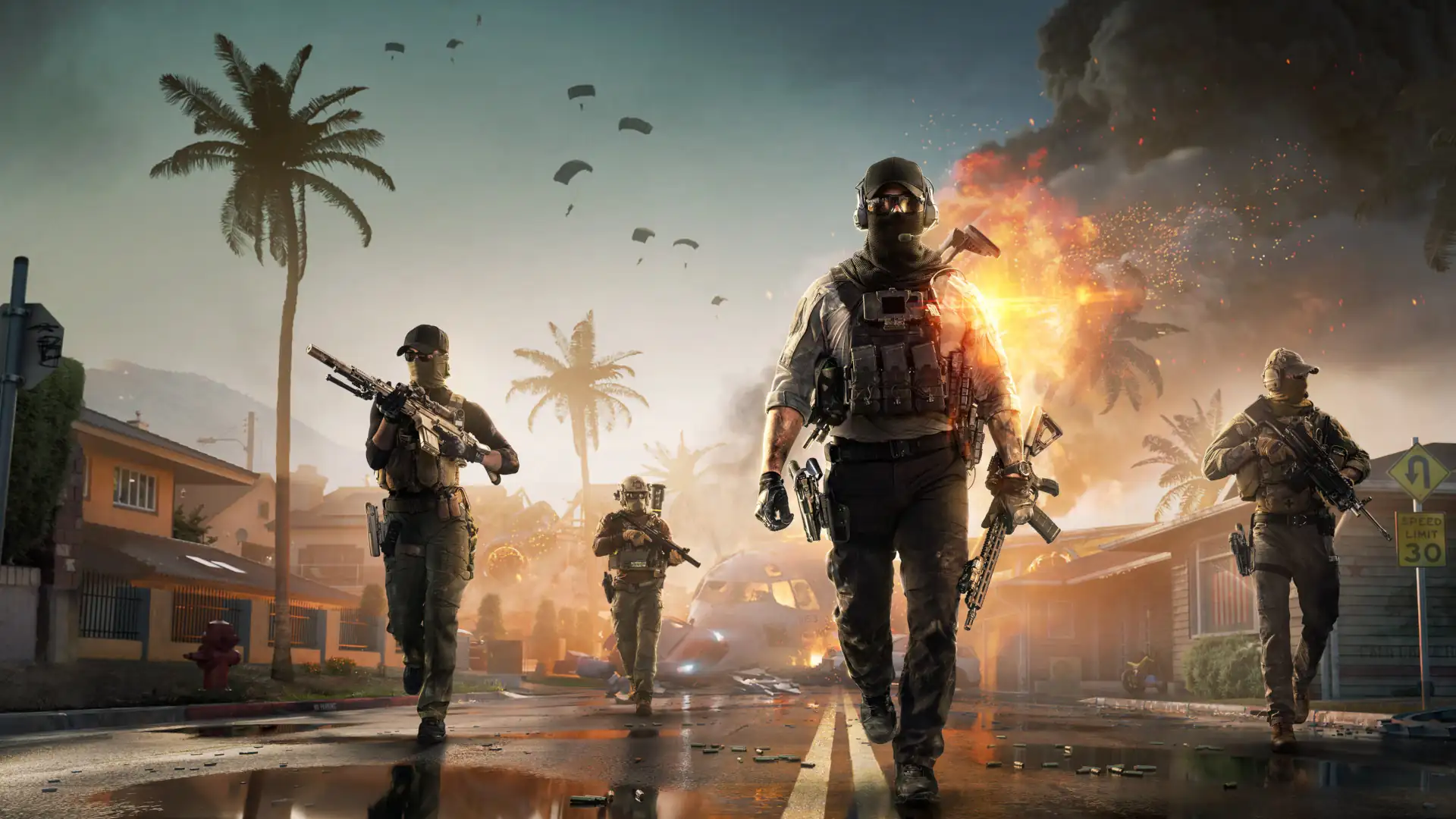
Series Overview
Battlefield is a premier military-themed game series developed by DICE (EA Digital Illusions CE) and published by Electronic Arts. The series began in 2002 with Battlefield 1942, and is available on Windows, PlayStation, and Xbox platforms. Renowned for its focus on large-scale sandbox warfare and environmental destruction, the franchise has redefined the spectacle of digital combat by oscillating between historical accuracy and speculative future conflicts.
Release Order Complete list of games series in Release Order.
| # | Game Title | Year | Platforms | |
|---|---|---|---|---|
| 1 | Battlefield 1942 | 2002 | PC, Mac | |
| 2 | Battlefield Vietnam | 2004 | PC | |
| 3 | Battlefield 2 | 2005 | PC | |
| 4 | Battlefield 2142 | 2006 | PC, Mac | |
| 5 | Battlefield: Bad Company | 2008 | PS3, Xbox 360 | |
| 6 | Battlefield 1943 | 2009 | PS3, Xbox 360 | |
| 7 | Battlefield: Bad Company 2 | 2010 | PC, PS3, Xbox 360, iOS | |
| 8 | Battlefield 3 | 2011 | PC, PS3, Xbox 360, iOS | |
| 9 | Battlefield 4 | 2013 | PC, PS3, PS4, Xbox 360, Xbox One | |
| 10 | Battlefield Hardline | 2015 | PC, PS3, PS4, Xbox 360, Xbox One | |
| 11 | Battlefield 1 | 2016 | PC, PS4, Xbox One | |
| 12 | Battlefield V | 2018 | PC, PS4, Xbox One | |
| 13 | Battlefield 2042 | 2021 | PC, PS4, PS5, Xbox One, Xbox Series X|S |
Chronological Order Complete list of games series in Chronological Order.
| # | Game Title |
|---|---|
| 1 | Battlefield 1 |
| 2 | Battlefield V |
| 3 | Battlefield 1942 |
| 4 | Battlefield 1943 |
| 5 | Battlefield Vietnam |
| 6 | Battlefield: Bad Company |
| 7 | Battlefield: Bad Company 2 |
| 8 | Battlefield 3 |
| 9 | Battlefield Hardline |
| 10 | Battlefield 2 |
| 11 | Battlefield 4 |
| 12 | Battlefield 2042 |
| 13 | Battlefield 2142 |
All Battlefield Series Overview Each game's plot guide includes minor spoilers.
1. Battlefield 1 (2016)
The narrative plunges into the chaotic heart of the First World War, abandoning a single protagonist for a gritty anthology of "War Stories" across the globe. From the muddy devastation of the Western Front to the scorching sands of the Arabian desert, the story captures a world in the throes of a brutal transition from old-world cavalry to mechanized slaughter. Characters like Danny Edwards, a young chauffeur turned tank driver, find themselves trapped in steel coffins as they navigate the terrifying novelty of armored warfare.
The friction intensifies as the perspective shifts to a diverse cast of conscripts and volunteers, each grappling with the dehumanizing scale of the conflict. In the Italian Alps, a member of the Arditi searches for his twin brother amidst a mountain-leveling assault, while a Bedouin rebel works alongside Lawrence of Arabia to sabotage the Ottoman Empire's iron grip. These disparate lives are linked by the shared realization that the "War to End All Wars" is a relentless machine that cares little for individual valor or national pride.
The thematic tension centers on the loss of innocence and the visceral weight of a world tearing itself apart. The narrative avoids glorifying the carnage, instead focusing on the intimate terror of a soldier realizing their own obsolescence in the face of chemical gas and heavy artillery. As the airmen over London and the infantry in the trenches face impossible odds, the story highlights the flickering moments of humanity that persist in the dark. The silence of the Armistice remains a distant hope as the characters are left to wonder if they are fighting for a future that will ever recognize their names.
2. Battlefield V (2018)
Set against the most pivotal moments of World War II, the story explores the "untold" facets of the global struggle through another series of focused vignettes. The journey begins with a British special operative infiltrating North Africa, before shifting to the frozen, perilous peaks of Norway where a young resistance fighter attempts to sabotage a German nuclear program. Each chapter highlights a different theater of the war, emphasizing the clandestine and often overlooked sacrifices that shifted the tides of history.
Conflict escalates as the narrative follows a group of Senegalese Tirailleurs fighting for a "motherland" they have never seen, only to be met with systemic prejudice within the very army they serve. In the final days of the Reich, a German tank crew begins to question the fanatical ideology that has led them to the brink of annihilation. The atmospheric tension is thick with the scent of burning oil and the psychological weight of a conflict that has moved beyond the reach of traditional morality.
The relationship between duty and conscience serves as the primary driver for these characters. They are not caricatures of heroism, but flawed individuals caught in the machinery of a total war that demands everything from them. The narrative builds a sense of pervasive dread as the scale of the destruction becomes impossible to ignore, forcing each protagonist to confront a personal moral crossroads. As the final shells fall on the ruins of Europe and the Pacific, the characters are left standing on a precipice, unsure if the peace they've secured can ever truly heal the scars of the front.
3. Battlefield 1942 (2002)
The world is a theater of absolute carnage in 1942, as the Axis and Allied powers collide across five major fronts of the Second World War. From the sweltering jungles of Guadalcanal to the bone-chilling ruins of Stalingrad, the narrative backdrop is one of total mobilization and shifting geopolitical tectonic plates. The story is not found in a single man's diary, but in the collective movement of armies across the Pacific, North Africa, and Eastern Europe.
The friction of the era is defined by the rapid evolution of technology and the desperate race for territorial dominance. The Allied forces struggle to establish a foothold on the beaches of Normandy, while the Imperial Japanese Navy engages in a lethal game of hide-and-seek among the atolls of the Pacific. Every skirmish is a micro-drama of survival, where the capture of a single airfield or a mountain pass could determine the fate of a continent. The narrative captures the sheer logistical nightmare of a world where every industry has been repurposed for the sake of victory.
The primary tension rests on the immense scale of the "Big War" and the anonymity of the soldiers who fueled it. The story emphasizes the tactical chess match between commanders and the raw courage required of the infantrymen tasked with executing their grand designs. As the conflict drags into the winter, the environmental hostility becomes as much of a threat as the enemy fire. The narrative leaves the world in a state of precarious balance, with the final outcome of the global struggle still hanging on the outcome of the next major offensive.
4. Battlefield 1943 (2009)
The conflict narrows its focus to the brutal, sun-drenched theater of the Pacific in 1943. As the United States Marine Corps pushes back against the Imperial Japanese Navy, the battle for supremacy centers on a series of strategically vital islands, including Wake Island and Iwo Jima. The air is thick with the humidity of the tropics and the constant roar of zero fighters overhead. The narrative premise is one of grueling island-hopping campaigns where every inch of sand is paid for in blood.
Tension escalates as the struggle moves from the shorelines into the dense, booby-trapped jungles of the interior. The soldiers are caught in a relentless cycle of coastal invasions and defensive stands, where the tropical environment is as much of an enemy as the opposing army. The narrative highlights the asymmetrical nature of the Pacific war, contrasting the massive firepower of the US fleet with the entrenched, fanatical resistance of the Japanese defenders. It is a story of attrition where the isolation of the islands amplifies the psychological weight of the combat.
The core tension is found in the clash of two unyielding wills in a theater far removed from the civilized world. The soldiers face a harrowing existence defined by heat, disease, and the constant threat of a banzai charge or a sniper's bullet. There is no diplomatic exit in sight; there is only the grim reality of a war that will only end when one side is completely spent. As the smoke rises over the volcanic ash of Iwo Jima, the narrative leaves the survivors staring at a horizon that promises only more of the same.
5. Battlefield Vietnam (2004)
The year is 1965, and the humid, emerald jungles of Vietnam have become a graveyard for traditional military doctrine. The story captures the escalating tension of the Cold War through the eyes of American GIs and North Vietnamese soldiers clashing along the Ho Chi Minh Trail. It is a conflict defined by the jarring contrast between high-tech napalm strikes and the silent, lethal ingenuity of guerrilla traps. The narrative explores the deep psychological rot of a war fought in a land where the enemy is indistinguishable from the environment.
Conflict intensifies as the American forces attempt to pacify the countryside through "Search and Destroy" missions that often result in more chaos than stability. The dense foliage provides a perfect shroud for the NVA and Viet Cong, who utilize a vast network of tunnels to vanish as quickly as they appear. The narrative highlights the cultural and political friction of the era, where the war on the ground is echoed by the social upheaval occurring back in the States. Every patrol into the tall elephant grass is a gamble with mortality, fueled by the haunting rhythm of rock and roll and the scent of burning jungle.
The thematic focus is on the disillusionment of the soldier and the futility of trying to impose order on a landscape that refuses to be tamed. The American protagonists find their technological advantages neutralized by the terrain, while the Vietnamese defenders face the overwhelming firepower of a global superpower. The relationship between the two sides is one of mutual, grinding attrition that strips away the romanticism of the conflict. As the helicopters lift off from a burning landing zone, the story leaves the characters in a cycle of violence that seems to have no defined exit point.
6. Battlefield: Bad Company (2008)
In the near future, the United States is embroiled in a fictional conflict with the Russian Federation, but for the members of "B-Company," the war is just a backdrop for a much more personal ambition. Preston Marlowe, a new transfer to this unit of misfits and troublemakers, discovers that his squad has decided to go AWOL after discovering a gold bar belonging to a private mercenary group. The narrative shifts from a standard military mission to a high-stakes heist across the border of a neutral nation.
The tension escalates as the "Bad Company" squad finds themselves pursued by both the Russian military and the ruthless Legionnaire mercenaries. Marlowe must navigate the friction within his own squad-led by the world-weary Sergeant Redford-while they improvise their way through one explosive situation after another. Their journey through the war-torn landscape is punctuated by a dark, cynical humor that mocks the traditional military-hero trope. They realize that in a world of global conflict, gold is the only currency that truly guarantees a way out.
The relationship between the four squad members becomes their only shield against the chaos they have invited upon themselves. The thematic focus is on the "expendable" nature of soldiers and the allure of a rogue life in a system that views them as collateral damage. The suspense is driven by their increasingly desperate attempts to secure the gold while staying one step ahead of the specialized hunters sent to retrieve it. As they close in on the mercenary leader's stronghold, the squad faces a choice between their duty and the fortune they've bled for.
7. Battlefield: Bad Company 2 (2010)
The misfits of B-Company are back, but their days of hunting gold have been replaced by a high-stakes mission for US Army Intelligence. Preston Marlowe and his squad are tasked with securing a "Scalar Weapon," a terrifying piece of experimental technology from the Second World War that has resurfaced in the hands of a rogue Russian General. The narrative takes them from the frozen mountains of Russia to the humid jungles of South America, uncovering a plot that could cripple the entire American electrical grid.
Conflict intensifies as the squad realizes they are being used as pawns in a geopolitical game that far exceeds their pay grade. They find themselves caught in a series of escalating engagements against a massive Russian invasion force that is utilizing the Scalar technology to pave its way. The banter between the squad members remains, but it is now underscored by a genuine fear of the global catastrophe looming on the horizon. The hunt for the weapon becomes a race against time, as the Russian General prepares a final, devastating strike against the American heartland.
The core tension revolves around the burden of being the only ones who know the truth in a world on the brink of collapse. Marlowe and his team must operate without official support, navigating a web of betrayal that reaches into the highest levels of their own military. The theme of "the right men in the wrong place" is central to their survival in a war that has moved beyond the battlefield into the realm of shadow operations. The suspense peaks as they board a cargo plane for a final, suicidal confrontation to stop the weapon's activation.
8. Battlefield 3 (2011)
The year is 2014, and Sergeant Henry "Black" Blackburn is being interrogated in a cold, sterile room by CIA agents who believe he is involved in a terrorist plot. The story is told through his flashbacks, recounting a series of operations in the Middle East against a radical paramilitary group known as the PLR. From the claustrophobic streets of Tehran to the grand boulevards of Paris, Blackburn's journey is a frantic hunt for a set of missing portable nuclear weapons. The narrative is a high-stakes political thriller that explores the "grey areas" of modern counter-terrorism.
Tension spirals as the interrogation reveals a much larger conspiracy involving a rogue Russian operative named Solomon. Blackburn's missions are intercut with the perspectives of a tank commander in the desert and a Spetsnaz agent attempting to stop a nuclear detonation in the heart of France. The narrative highlights the friction between international intelligence agencies and the soldiers on the ground who are forced to deal with the fallout of their failures. Every memory Blackburn relives brings the world closer to a global conflict that could ignite a war between the US and Russia.
The thematic focus is on the "fog of war" and the personal cost of doing what is necessary when the official channels fail. Blackburn is a man caught between his duty to his country and his own moral compass, eventually forced to go rogue to stop Solomon's final plan. The relationship between the interrogators and the prisoner provides a framing device that heightens the sense of impending doom. As the clock ticks down to a potential catastrophe in New York City, Blackburn must escape his captors to deliver the final strike.
9. Battlefield Hardline (2015)
In the sun-bleached, drug-riddled streets of Miami, rookie detective Nick Mendoza finds that the war on crime is just as lethal as any foreign battlefield. Partnered with the cynical veteran Khai Minh Dao, Mendoza is thrust into a sprawling investigation into a new drug supply that leads to the highest levels of police corruption. The narrative is a departure from the series' military roots, focusing on a gritty, television-style crime drama where the line between the law and the underworld is dangerously thin.
The conflict escalates when Mendoza is betrayed and framed by his own corrupt superiors, leading to a multi-year stint in prison. Upon his release, he joins a group of former colleagues to exact revenge and expose the truth of the drug ring. The journey takes them from the high-rises of the city to the desolate beauty of the California desert, utilizing stealth and tactical arrests rather than just raw firepower. The narrative highlights the friction within the police force and the personal cost of seeking justice in a system that has been bought and paid for.
The core tension centers on Mendoza's struggle to remain a "good cop" in a world of moral decay. The relationship between Nick and Khai evolves from professional partners to fugitives bound by a shared desire for retribution. The theme of "hardline" justice explores the extremes to which an individual will go when the law fails to protect the innocent. As Mendoza closes in on the man who destroyed his life, the suspense rests on whether he will use his badge or his gun to finish the job.
10. Battlefield 2 (2005)
The early 21st century is consumed by a theoretical "Triple Alliance" conflict between the United States, the People's Republic of China, and the fictional Middle Eastern Coalition (MEC). The narrative backdrop is one of high-tech, mechanized warfare for the control of the world's remaining natural resources and strategic territory. From the industrial shipping hubs of the Persian Gulf to the dense urban centers of the East, the world is a chessboard of modern military might. It is a story of superpowers in a state of total, conventional war.
Friction is fueled by the rapid deployment of specialized military units and the logistical complexity of managing a global front. The US Marine Corps finds itself engaged in a brutal war of attrition against the MEC defenders, while Chinese forces launch a series of ambitious offensives to secure the Asian theater. Every engagement is a testament to the lethality of modern weaponry, where a single drone strike or a precision-guided missile can alter the course of an entire campaign. The narrative captures the clinical, devastating efficiency of 21st-century combat.
The primary tension rests on the concept of global dominance and the immense human cost of maintaining a superpower's influence. The story highlights the reliance on technology and the specialized roles within the modern military machine, from the medics on the front line to the commanders in the rear. As the three factions pour their resources into a conflict that seems to have no clear winner, the environmental toll of the war begins to mirror the physical destruction of the cities. The narrative leaves the world in a state of permanent mobilization, with no end in sight for the global struggle.
11. Battlefield 4 (2013)
The world is on the brink of a new global conflict as political tensions in China reach a boiling point following the assassination of a prominent peace advocate. Sergeant Daniel "Reck" Recker and his elite Tombstone squad are deployed to Shanghai to extract a group of high-profile VIPs, only to find themselves caught in the middle of a military coup led by the radical Admiral Chang. The narrative follows the squad as they navigate a sinking carrier, the streets of Singapore, and the snowy peaks of the Kunlun Mountains in a desperate attempt to prevent a full-scale war between the US and China.
The conflict intensifies as Tombstone realizes they are the only ones capable of stopping Chang's alliance with the Russian Federation. They are joined by a female Chinese secret service agent named Hannah, whose presence creates an atmosphere of distrust and friction within the squad. As they are hunted across Asia, the squad must survive brutal interrogation and a harrowing escape from a high-security prison. The narrative highlights the fragility of international alliances and the personal sacrifices required of those who operate in the shadows of geopolitical collapse.
The thematic focus is on the "human element" in a war dominated by massive machinery and digital intelligence. The bond between Recker and his squad members, particularly the vocal and passionate Irish, provides the emotional weight for the mission. The relationship with Hannah serves as a constant reminder that the war is as much about ideology as it is about territory. As they prepare for a final, suicidal assault on Chang's flagship, the suspense rests on a single, agonizing choice that will determine the fate of the entire mission.
12. Battlefield 2042 (2021)
By the year 2042, the world has been devastated by a decade of environmental collapse, economic ruin, and the total dissolution of many sovereign nations. The narrative premise focuses on the "No-Pats"-stateless refugees and mercenaries from fallen countries who have been forced to fight for the world's two remaining superpowers, the US and Russia. In a world of surging sea levels and catastrophic storms, these specialists find themselves caught in a proxy war for the planet's final, dwindling resources. The conflict is no longer about flags, but about the survival of the stateless.
Tension escalates as the "Non-Patriated" units realize they are being used as expendable currency by the superpowers who caused the world's collapse. They must navigate a landscape of high-tech warfare and extreme weather, where a massive sandstorm or a tornado can be just as deadly as an enemy platoon. The narrative explores the individual backstories of these specialists-doctors, hackers, and veterans-who have lost everything but their will to fight. Every skirmish in the ruins of an abandoned shipping hub or a flooded city is a desperate scramble for the "data drives" and supplies needed to keep their communities alive.
The core tension centers on the loss of national identity and the ethics of fighting for the very powers that abandoned you. The No-Pats are a community of the lost, forced to cooperate with their former enemies to ensure a future for the next generation of stateless children. The theme of "the world left behind" is central, as the protagonists face the realization that the earth they are fighting for may already be beyond saving. The suspense remains on the horizon of a world in permanent flux, where the only constant is the next storm.
13. Battlefield 2142 (2006)
In the late 22nd century, a new Ice Age has buried much of the northern hemisphere under miles of permafrost, triggering a global war for the remaining habitable land near the equator. The European Union (EU) and the Pan Asian Coalition (PAC) are locked in a desperate, high-tech struggle for survival as the glaciers continue their relentless advance. The narrative is defined by the presence of "Titans"-massive, flying warships that serve as mobile bases and symbols of each faction's military might. It is a war of absolute survival in a world that is literally freezing to death.
The conflict is a brutal display of futuristic warfare, featuring walking bipedal mechs and sophisticated cloaking technology. The PAC forces launch a massive invasion into the EU's final territories in North Africa and the Middle East, leading to a series of devastating urban and desert engagements. The narrative highlights the technological friction of the era, where the race to develop more lethal weaponry is a race against the clock of an encroaching ice sheet. Every city captured is a potential sanctuary for a population that has nowhere else to go.
The thematic focus is on the "nihilism of the future" and the cold reality of a species fighting for the scraps of a dying planet. The soldiers are no longer fighting for ideology or religion, but for the simple right to exist in the warmth. The relationship between the two factions is one of total, uncompromising war where the environment is the ultimate victor. The suspense peaks as the EU launches a final, desperate counter-offensive to board and destroy the PAC Titans before their defenses collapse. The narrative leaves the world in a state of perpetual winter, with the final flicker of human civilization hanging by a thread.
All Battlefield Games in Order: A comprehensive list of the franchise, organized by release and chronological order. Information is curated from web sources and highlights mainline entries only. Note: This guide does not include DLCs or remakes, focusing strictly on primary Battlefield titles for a cleaner browsing experience.